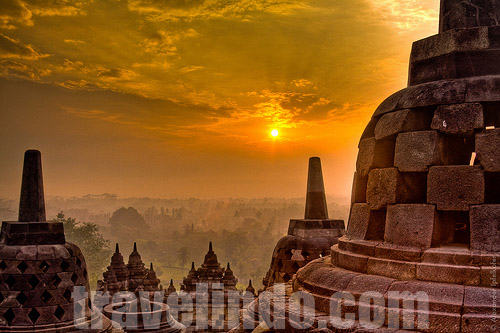
Sewu Temple complex is situated on the area of Prambanan Temple Park, about 800
meters to the north of Rara Jongrang Temples. Sewu Temple is the second largest
Buddhist temple in central Java after Borobudur. The fact that this temple was
built near Prambanan Temple, which is a Hindu temple, indicated that the Hindus
and Buddhists lived in harmony.
It is believed to be a royal temple and was one of the religious activity centers
in the past. Based on the inscription dated back to 792 AD which was found in
1960, the name of the temple complex was probably “Manjus’rigrha” (The House of
Manjusri). Manjusri is one of Boddhisatva in Buddhist teaching. Sewu Temple was
probably built in the 8th century at the end of Rakai Panangkaran administration.
Rakai Panangkaran (746 AD-784 AD) was a popular king from the old Mataram kingdom.The
temple was studied firstly by HC Cornellius in 1807. The first archeological study
was done by NJ Krom in 1923.
The massive restoration was carried out from April 1, 1983 to 1993 costed 3 billion
rupiah. Sewu Temple complex has 249 temples, consists of one main temple, 8 “Apit”
temples and 240 “Perwara” temples. The main temple forms a polygon of 20 corners
with 29 meters diameter and 30 meters high. Most of the structures were made up
of andesit stone.
The main temple has one main room and four small rooms of which are doorways
to the temple. The east door serves as main door to the main room. That way, the
main temple faces to the east.
The main Sewu temple has nine roofs that consists of four roof door, four corridor
roof, and one main room roof that all of the top form stupa. The main room roof
is the highest and the greatest that consists of three levels.