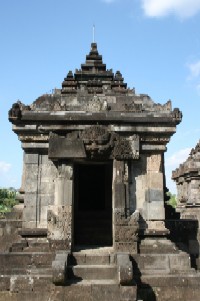
Candi Plaosan is a temple to be constructed during Java’s “Classic Age” that
has survived into modern times. This amazing site is located just over a kilometer
to the Northeast of Prambanan Temple. Plaosan temple consists of three-construction
group; Central, Northern, and Southern group. Each group consists of main building,
while numerous smaller buildings are surrounding.
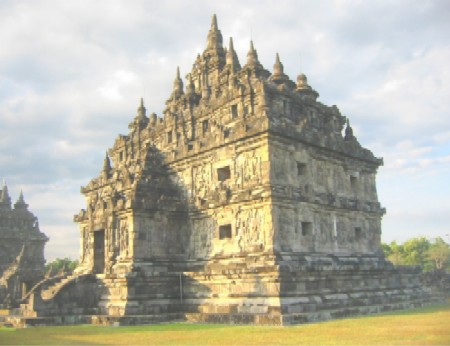
Attached on 23 m x 22 m basement, the two Viharas on Central group consist of
three levels construction full of ornaments, carving and statues. Eight steps
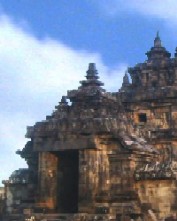
stairways in the west side lead up to entranceway of the Vihara. The entranceway,
which is 1.26 m wide and 1.52 m in depth, decorated with a makara heads resting
on the backs of decumbent elephants. Each vihara’s singular stairway features
wings to either side that are decorated with creeper-style ornaments.
The first level measures 18.85 m from North to South and 11.17 m from East to
West. This former ancient viharas show the richness of ornaments both on the
outside and the inside of the building. At the outside walls on the first level,
there are 18 panels (6 on the East side, and 4 each on the other 3 sides). On
the second level, 20 more panels on the walls and 2 more that flank the entranceway
on the building. Each of these 40 panels contains a beautiful rendition of a
standing male figure. Continuing to the next level, both viharas possess a false
third level that includes 16 niches: five each in the East and West as well as
three more in the North and South. The roofs of each Vihara collectively support
41 stupas. The main stupa at the center of the roof is closely surrounded by
two descending stage of 8 stupas each. 3 each at the North and South ends of
the roof and 2 more within the space between the North and South end of the roof
and the roof center. A total of 5 smaller stupas have been placed in a line on
both the West and the East sides of the roof. |
|
Entering the vihara, one encounters an entrance with two niches in the left and
right. Stepping to the 2.18 m x 2.34 m central room of the vihara, In the middle
of each side wall is a niche decorated with the kala-makara art motif. There
are a two Access-ways leading off to two additional chambers located to the right
and left. The three chambers inside the Vihara are similar in design and measurement.
There are Bodhisattva-images with the left leg folded back towards the groin,
with the right leg fully extended, and with the right foot resting on a lotus
cushion and an altar between them. On the right and left side of each chamber
wall there are niches in each side. The structural design here is precisely identical
between the South and the North Vihara at the central group of Candi Plaosan.
|
|
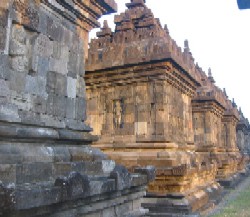
Out side the twin Viharas courtyard, originally there are 174 subsidiary structures
surrounding outside the wall. These subsidiary structures organized into three
ranks. First rank contains 50 structures, second rank 58, while the third rank
contains 66 structures.
The first rank contains of 50 structures in shape of 3.4 m x 3.4 m small chambers
on the 4.9 m x 4.9 m square basement with a staircase which project 75 cm outward.
19 prasadas in the East side facing to the East. 17 in the West side facing to
the West, 7 in the North facing to north and the 7 in the South facing to the South. These small chambers called prasada. These particular buildings had originally
contained images of Amitabha (W), Aksobhya (E), Ratnasambhava (S) and Amoghasiddhi
(N). |
The second rank is comprised of 58 subsidiary buildings. 54 of them are in the
shape of stupas while the 4 of them are in shape of prasada located in the four
corners. The third rank consists of 66 structures, out of which 62 are of the
previously described stupa-type; the remaining 4 structures in the four corners
are once again of the prasada-type.
South and North Group
The Northern construction-group at Plaosan temple consists of central courtyard
that is surrounded by a wall and with its entranceway in the West. In the center
of the courtyard, there is a raised platform (pendopo). The platform measures 21.62 m from North to South and 19.0 m from East to
West with a staircase in west side. Along the four-side edges of the platform,
24 quadrangular stone rise up from the floor. They appear originally served as
the support for four-sided wooden columns. Inside the quadrangular stone circle,
there are 16-octagon stone projections following the outer perimeter. Perhaps
they had served as the supports for wooden columns featuring eight sides.
In the east side of the platform, 11 sacred images facing to the west situated
on the 1.5 m x 17.5 m x 78 cm altar. On the left and right side of the east
altar, there is 1.28 m x 7.0 m x 78 cm altar with five sacred figures on each
of them.
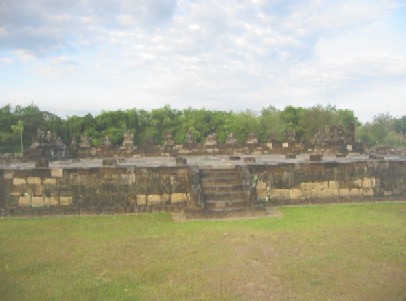
At Plaosan Kidul Temple, one also finds a square terrace platform in the middle
of the yard. It was surrounded on the West side by two ranks of eight small temples
with four in each range on either side of the passage that ran from the terrace
to the entrance in the surrounding ring wall; the larger and more beautiful ones
were reportedly placed in the second file beside the passage. All of these faced
to the West. On the three other sides of the centrally placed terrace, 45 stupas were
organized in three ranks.