From Prambanan temple, it is only about three kilometers southward to reach
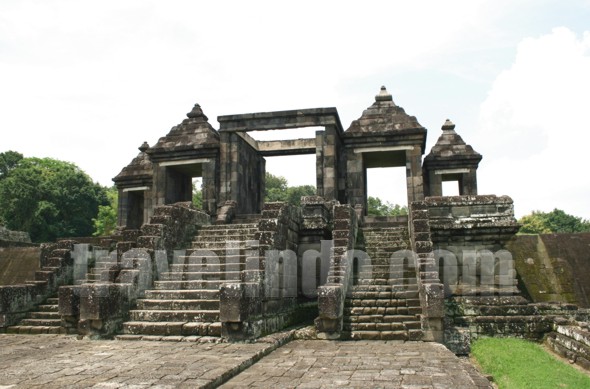
the compound of Kraton Ratu Boko temple. The temple is more like an artistic palace
than common temple. It can be seen from the gates and the other attributes that
are now still beautifully standing on the area.
The complex is located 196 meters above the sea level. On the highest point of
the site, there is a small pavilion where we will be able to see a beautiful
panorama of Prambanan temple with Mount Merapi as the background. This site covers
16 hectares in two hamlets (Dawung and Sambireja) of the village of Bokoharjo,
Prambanan, Yogyakarta, Indonesia.
Different from other temples in Yogyakarta and Central Java, the site of Ratu
Boko has a special characteristic. Common monuments in Yogyakarta and Central
Java usually consist of temples (holy building); however Ratu Boko temple compound
has no holy buildings (temples) and even has several profane buildings. It can
be seen by building used as living place such as pool and cave.
This palace was initially found by a Dutch arkeolog, HJ De Graaf in 17 century.
At present, the complex consists of:
The pendopo, the three temples, the pools and the kaputren are located on the
south east. The existence of these buildings indicates the characteristic of a
royal palace. Nowadays, the site’s name, the architect, and the function
of the temple remain uncertain. Some people believe it was the former palace of ancient
Mataram Kingdom or a fortress; other scholars interpret this site was a monastery.
The other group presumes it was a place for rest and recreation. All of the opinions above were unclear, the local folks believe that this site
was King Boko’s palace;
the legendary character mentioned in Roro Jonggrang myths and named it after him.