YOGYAKARTA PLACE OF INTEREST: BOROBUDUR TEMPLE
Tuesday, 03 April 2012
BOROBUDUR TEMPLE
Only few people really know about Borobudur temple. Most of them are only familiar with its general description. What about the others? There are many things about Borobudur you have to know. Its mystery, at the present is still attempting to be discovered. Its glory, until now is still being adored by the people around the world. Its phenomenon, in recent times is still worthy to be observed.
Borobudur is a huge Buddhist temple lies magnificently in Magelang, Central Java, Indonesia. Located approximately 40 km northwest of Yogyakarta, it is positioned on an elevated area between two twin volcanoes, Sindoro-Sumbing at the north-west and Merapi-Merbabu at the northeast, and the Progo River. It is precisely located on the coordinates: 7°36′29″S 110°12′00″E/-7.608, 110.20.
This temple is different from other temples, that common temples were usually built on a flat surface; however Borobudur was built on a solid rock hill, 265 m above sea level and 15 m above the floor of the dried-out lake.
At the western and the southern sides, there is a long series of hills that form a rocky skyline of huge masses of unclear shape named “Menoreh range”. Menoreh stands for menara and means ‘tower’ that is remarkable when it is viewed from Borobudur temple. From Borobudur, it looks like the sketch of a man lying on the point of the hill. The nose, lips and chin are clearly outlined. Some say that the ridge portrays Gunadharma, the architect of Borobudur temple who is watching the monument.
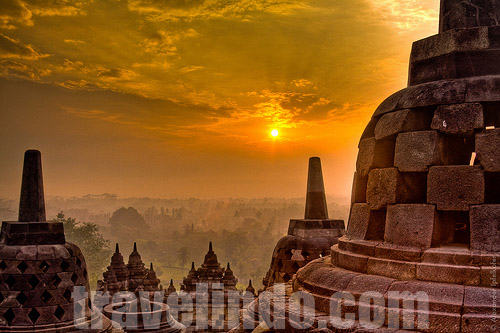
Borobudur consists of six rectangle platforms topped by three circular platforms. It is ornamented with 2.672 relief panels and 504 Buddha statues. A main dome is located at the center of the top platform, and is surrounded by seventy-two Buddha statues seated inside perforated stupa. It consists of ten stages that symbolize the ten levels to be achieved by human beings to be the Buddha.
The shrine is both a place of worship to the Lord Buddha and a place for Buddhist pilgrimage. The journey for pilgrims begins at the base of the monument and follows a path leading to the monument while ascending to the top through the three levels of Buddhist cosmology, namely, Kamadhatu (the world of desire); Rupadhatu (the world of forms); and Arupadhatu (the world of formless). During the journey, the monument guides the pilgrims through a system of stairways and corridors with 1,460 narrative relief panels on the wall.
Evidence suggests that Borobudur was abandoned following the fourteenth century decline of Buddhist and Hindu kingdoms in Java, and the Javanese conversion to Islam. Then in 1814, it was rediscovered by Sir Thomas Raffles, the British ruler of Java. Afterward, Borobudur has been preserved for several times during that time. The biggest restoration was undertaken between 1975 and 1982 by the Indonesian government and UNESCO. And by UNESCO, Borobudur listed as a World Heritage Site.
Though recently it is no longer used as a place of worship, Borobudur is still used for pilgrimage, and once a year Buddhists in Indonesia celebrate Vesak at this temple. Once a year, during the full moon in May or June, Buddhists in Indonesia observe Vesak (Indonesian: Waisak) day commemorating the birth, death, and the time when Siddhartha Gautama attained the highest wisdom to become the Buddha Shakyamuni. Vesak is an official national holiday in Indonesia and the ceremony is centered at the three Buddhist temples by walking from Mendut to Pawon and ending at Borobudur.
Talking about the name of Borobudur, no one really knows the origins name of Borobudur. There are many theories that try to explain the name of borobudur temple. One of them states that the word Borobudur is derived from Sambharabhudhara, which means “a mountain” (bhudara) where its hill is situated in terracing. While the people think that borobudur come from the word “"para Buddha” or “the Buddhist” that distracts it into borobudur.
One theory also states that the name 'Bore-Budur', and thus 'BoroBudur', is thought to have been written by Raffles in English grammar to mean the nearby village of Bore; most candi are named after a nearby village. If it followed Javanese language, the monument should have been named 'BudurBoro'. Raffles also suggested that 'Budur' might correspond to the modern Javanese word Buda ('ancient') - i.e., 'ancient Boro'. Another hypothesis says that 'Boro' was taken from an old Javanese term bhara ('honorable'), describing the monument as "The Honorable Buddha". Another interpretation comes from the Javanese word biara ('monastery'), or 'monastery of Budur'.
According to the Javanese dynasty, Borobudur seems to be discovered around AD 800. This corresponds to the period between AD 760–830, the peak of the Sailendra dynasty in Central Java. The construction is estimated to have taken 75 years and was completed in 825, during the reign of Srivijayan Maharaja Samaratunga.
For centuries, Borobudur lay hidden under layers of volcanic ash and jungle growth. The facts behind the desertion of the monument remain a mystery. It is unknown until when the monument was still in active use and when it ceased to function as the pilgrimage center of Buddhism. A general assumption is that the temples were disbanded when the populations were converted to Islam in the fifteenth century. Another theory is that a famine caused by a volcanic eruption (around AD 1006) had forced local inhabitants to leave their lands and the monument.
In 1814, Java was under British administration that led by a governor Lieutenant Governor-General Thomas Stamford Raffles. After being informed about a big monument called Borobudur, he men cut down trees, burned down vegetation and dug away the earth to reveal the monument. In the whole monument was finally revealed.
After restoration, on 21 January 1985 was attacked. Nine stupas were badly damaged by nine bombs. In 1991, a blind Muslim evangelist, Husein Ali Al Habsyie, was sentenced to life imprisonment for masterminding a series of bombings in the mid 1980s including the temple attack. Two other members of a right-wing extremist group that carried out the bombings were each sentenced to 20 years in 1986 and another man received a 13-year prison term. On 27 May 2006, an earthquake of 6.2 magnitudes on Richter scale struck the south coast of Central Java. The event had caused severe damage around the region and victims to the nearby city of Yogyakarta, but Borobudur, however, was unharmed.
The Structure
As a temple, Borobudur is built as a single large stupa. If it is viewed from above, it takes the form of a giant tantric Buddhist mandala, simultaneously representing the Buddhist cosmology and the nature of mind. The foundation is a square, approximately 118 meters on each side. It has nine platforms, of which the lower six are square and the upper three are circular. The upper platform features seventy-two small stupas surrounding one large central stupa. Each stupa is bell-shaped and pierced by numerous decorative openings. Statues of the Buddha sit inside the pierced area.
As a temple, Borobudur is built as a single large stupa. If it is viewed from above, it takes the form of a giant tantric Buddhist mandala, simultaneously representing the Buddhist cosmology and the nature of mind. The foundation is a square, approximately 118 meters on each side. It has nine platforms, of which the lower six are square and the upper three are circular. The upper platform features seventy-two small stupas surrounding one large central stupa. Each stupa is bell-shaped and pierced by numerous decorative openings. Statues of the Buddha sit inside the pierced area.
Roughly, 55,000 m³ of stones were taken from nearby rivers to construct the monument. Those stones were cut to size, transported to the site and laid without mortar. Knobs, indentations and dovetails were used to form joints between stones. Reliefs were created in-situ after the building had been completed. The monument is equipped with a good drainage system to cater for the area's high storm water run-off. To avoid flood, 100 spouts are provided at each corner with unique carved gargoyles called makaras.
Borobudur differs markedly with the general design of other structures built for this purpose. Instead of building on a flat surface, Borobudur is built on a natural hill. The building technique is, however, similar to other temples in Java. With no inner space as in other temples and its general design similar to the shape of pyramid, Borobudur was first thought more likely to have served as a stupa, instead of a temple. A stupa is intended as a shrine for the Lord Buddha. Sometimes, stupas were built only as devotional symbols of Buddhism. A temple, on the other hand, is used as a house of deity and has inner spaces for worship. The complexity, however, of the monument's meticulous design suggests it is in fact a temple. Congregational worship in Borobudur is performed by means of pilgrimage. Pilgrims were guided by the system of staircases and corridors ascending to the top platform. Each platform represents one stage of enlightenment. The path that guides pilgrims was designed with the symbolism of sacred knowledge according to the Buddhism cosmology.
Borobudur differs markedly with the general design of other structures built for this purpose. Instead of building on a flat surface, Borobudur is built on a natural hill. The building technique is, however, similar to other temples in Java. With no inner space as in other temples and its general design similar to the shape of pyramid, Borobudur was first thought more likely to have served as a stupa, instead of a temple. A stupa is intended as a shrine for the Lord Buddha. Sometimes, stupas were built only as devotional symbols of Buddhism. A temple, on the other hand, is used as a house of deity and has inner spaces for worship. The complexity, however, of the monument's meticulous design suggests it is in fact a temple. Congregational worship in Borobudur is performed by means of pilgrimage. Pilgrims were guided by the system of staircases and corridors ascending to the top platform. Each platform represents one stage of enlightenment. The path that guides pilgrims was designed with the symbolism of sacred knowledge according to the Buddhism cosmology.
Speaking of Borobudur, it would be incomplete if we do not know about the architect. It is only a little to be known about the architect, Gunadharma. His name is actually recounted from Javanese legendary folk tales rather than written in old inscriptions. He was said to be one who “... bears the measuring rod, knows division and thinks himself composed of parts”. The basic unit measurement he used during the construction was called tala, defined as the length of a human face from the forehead's hairline to the tip of the chin or the distance from the tip of the thumb to the tip of the middle finger when both fingers are stretched at their maximum distance. The unit metrics is then obviously relative between persons, but the monument has exact measurements. A survey conducted in 1977 revealed frequent findings of a ratio of 4:6:9 around the monument. The architect had used the formula to lay out the precise dimensions of Borobudur. The identical ratio formula was further found in the nearby Buddhist temples of Pawon and Mendhut. Archeologists conjectured the purpose of the ratio formula and the tala dimension has calendrical, astronomical and cosmological themes, as of the case in other Buddhist temple of Angkor Wat in Cambodia.
Borobudur has the main vertical structure that can be divided into three groups: base (or foot), body, and top, which resembles the three major division of a human body. The base is a 123x123 m² square in size and 4 meters high of walls. The body is composed of five square platforms each with diminishing heights. The first terrace is set back 7 meters from the edge of the base. The other terraces are set back by 2 meters, leaving a narrow corridor at each stage. The top consists of 3 circular platforms, with each stage supporting a row of perforated stupas, arranged in concentric circles. There is one main dome at the center; the top of which is the highest point of the monument (35 meters above ground level). Access to the upper part is through stairways at the centre of each side with a number of gates, watched by a total of 32 lion statues. The main entrance is at the eastern side, the location of the first narrative reliefs. On the slopes of the hill, there are also stairways linking the monument to the low-lying plain.
Borobudur has the main vertical structure that can be divided into three groups: base (or foot), body, and top, which resembles the three major division of a human body. The base is a 123x123 m² square in size and 4 meters high of walls. The body is composed of five square platforms each with diminishing heights. The first terrace is set back 7 meters from the edge of the base. The other terraces are set back by 2 meters, leaving a narrow corridor at each stage. The top consists of 3 circular platforms, with each stage supporting a row of perforated stupas, arranged in concentric circles. There is one main dome at the center; the top of which is the highest point of the monument (35 meters above ground level). Access to the upper part is through stairways at the centre of each side with a number of gates, watched by a total of 32 lion statues. The main entrance is at the eastern side, the location of the first narrative reliefs. On the slopes of the hill, there are also stairways linking the monument to the low-lying plain.
The three monument's division symbolizes three stages of mental preparation towards the ultimate goal according to the Buddhism cosmology, namely Kamadhatu (the world of desires), Rupadhatu (the world of forms), and finally Arupadhatu (the formless world). Kamadhatu is represented by the base, Rupadhatu by the five square platforms (the body), and Arupadhatu by the three circular platforms and the large topmost stupa. The architectural features between three stages have methaporical differences. For instance, square and detailed decorations in the Rupadhatu disappear into plainless circular platforms in the Arupadhatu to represent how the world of forms - where men are still attached with forms and names - changes into the world of the formless.
In 1885, a hidden structure under the base was accidentally discovered. The "hidden foot" contains reliefs, 160 of which are narrative describing the real Kamadhatu. The remaining reliefs are panels with short inscriptions that apparently describe instruction for the sculptors, illustrating the scene to be carved. An encasement base hides the real base of which their function remains a mystery. It was first thought that the real base had to be covered to prevent a disastrous subsidence of the monument through the hill. There is another theory that the encasement base was added because the original hidden foot was incorrectly designed, according to Vastu Shastra, the Indian ancient book about architecture and town planning. The encasement base, however, was built with detailed and meticulous design with aesthetics and religious compensation.
Borobudur contains approximately 2,670 individual bas reliefs (1,460 narrative and 1,212 decorative panels), which cover the façades and balustrades. The total relief surface is 2,500 m² and they are distributed at the hidden foot (Kamadhatu) and the five square platforms (Rupadhatu).
The narrative panels, which tell the story of Sudhana and Manohara, are grouped into 11 series encircled the monument with the total length of 3,000 meters. The hidden foot contains the first series with 160 narrative panels and the remaining 10 series are distributed throughout walls and balustrades in four galleries starting from the eastern entrance stairway to the left. Narrative panels on the wall read from right to left, while on the balustrade read from left to right. This conforms with pradaksina, the ritual of circumambulation performed by pilgrims who move in a clockwise direction while keeping the sanctuary to their right.
The hidden foot depicts the story of the karma law. The walls of the first gallery have two superimposed series of reliefs; each consists of 120 panels. The upper part depicts the biography of Buddha, while the lower part of the wall and also balustrades in the first and the second galleries tell the story of Buddha's former lives. The remaining panels are devoted to Sudhana's further wandering about his search; terminated by his attainment of the Perfect Wisdom.
Panel distribution
|
Section |
Location |
Story |
Panels |
|
Hidden Foot |
Wall |
Karmavibhangga |
160 |
|
Fist Gallery |
Main wall |
Lalitavistara |
120 |
|
Jataka/Avadana |
120 | ||
|
Balustrade |
Jataka/Avadana |
372 | |
|
Jataka/Avadana |
128 | ||
|
Second Gallery |
Main wall |
Gandavyuha |
128 |
|
Balustrade |
Jataka/Avadana |
100 | |
|
Third Gallery |
Main wall |
Gandavyuha |
88 |
|
Balustrade |
Gandavyuha |
88 | |
|
Fourth Gallery |
Main wall |
Gandavyuha |
84 |
|
Balustrade |
Gandavyuha |
72 | |
|
Total |
1.460 | ||
The law of karma (Karmavibhangga)
Karmavibhangga is the first manuscript describing the doctrine of cause and effect of good and evil. This series of relief is not visible as it is surrounded by broad base of stone walls. Only parts of the southeast side were dismantled for visitors
Karmavibhangga is the first manuscript describing the doctrine of cause and effect of good and evil. This series of relief is not visible as it is surrounded by broad base of stone walls. Only parts of the southeast side were dismantled for visitors
The 160 hidden panels do not form a continuous story, but each panel provides one complete illustration of cause and effect. There are depictions of blameworthy activities, from gossip to murder, with their corresponding punishments. There are also praiseworthy activities that include charity and pilgrimage to sanctuaries, and their subsequent rewards. The pains of hell and the pleasure of heaven are also illustrated. There are scenes of daily life, complete with the full panorama of samsara (the endless cycle of birth and death).
The birth of Buddha (Lalitavistara)
Lalitavistara is the second visual manuscript, Lalitavistara represents the life of Buddha Gautama from his birth until his first Sermon at Benares. One full round on the first Gallery (upper main wall) was dedicated to this manuscript.
The story starts from the glorious descent of the Lord Buddha from the Tushita heaven, and ends with his first sermon in the Deer Park near Benares. The relief shows the birth of Buddha as Prince Siddharta, son of King Suddhodana and Queen Maya of Kapilavastu (in present-day Nepal).
Lalitavistara is the second visual manuscript, Lalitavistara represents the life of Buddha Gautama from his birth until his first Sermon at Benares. One full round on the first Gallery (upper main wall) was dedicated to this manuscript.
The story starts from the glorious descent of the Lord Buddha from the Tushita heaven, and ends with his first sermon in the Deer Park near Benares. The relief shows the birth of Buddha as Prince Siddharta, son of King Suddhodana and Queen Maya of Kapilavastu (in present-day Nepal).
The story is preceded by 27 panels showing various preparations, in heavens and on earth, to welcome the final incarnation of Bodhisattva. Before descending from Tushita heaven, Bodhisattva entrusted his crown to his successor, the future Buddha Maitreya. He descended on earth in the shape of white elephants with six tusks, penetrated to Queen Maya's right womb. Queen Maya had a dream of this event, which was interpreted that his son would become either a sovereign or a Buddha.
While Queen Maya felt that it was the time to give the birth, she went to the Lumbini park outside the Kapilavastu city. She stood under a plaksa tree, holding one branch with her right hand and she gave birth to a son, Prince Siddharta. The story on the panels continues until the prince became Buddha.
Prince Siddharta story (Jataka) and other legendary persons (Avadana)
Jataka or Garland of Jatakas is a collection of poems consisting of 34 Jatakas. Based on manuscript written by Aryacara in the 4th century, these Jatakas contain stories on great deeds performed by Buddha in his former lives. These episodes of reincarnations serve as example of self-sacrifice.
Prince Siddharta story (Jataka) and other legendary persons (Avadana)
Jataka or Garland of Jatakas is a collection of poems consisting of 34 Jatakas. Based on manuscript written by Aryacara in the 4th century, these Jatakas contain stories on great deeds performed by Buddha in his former lives. These episodes of reincarnations serve as example of self-sacrifice.
Avadanas illustrated narrative are similar to Jatakas in which Buddha is not directly performing principal lead. These visual manuscripts describe deeds accomplished by Bodhisattvas in their former lives, preparing for Buddhahood.
Jatakas are stories about the Buddha before he was born as Prince Siddharta. Avadanas are similar with jatakas, but the main figure is not Bodhisattva himself. The saintly deeds in avadanas are attributed to other legendary persons. Jatakas and avadanas are treated in one and the same series in the reliefs of Borobudur.
Jatakas are stories about the Buddha before he was born as Prince Siddharta. Avadanas are similar with jatakas, but the main figure is not Bodhisattva himself. The saintly deeds in avadanas are attributed to other legendary persons. Jatakas and avadanas are treated in one and the same series in the reliefs of Borobudur.
The first 20 lower panels in the first gallery on the wall depict the Sudhanakumaravadana or the saintly deeds of Prince Sudhanakumara. The first 135 upper panels in the same gallery on the balustrades are devoted to the 34 legends of the Jatakamala. The remaining 237 panels depict stories from other sources, as do for the lower series and panels in the second gallery. Some jatakas stories are depicted twice, for example the story of King Sibhi.
Sudhana search of the Ultimate Truth (Gandavyuha)
The most important part of Buddhist world is written in the Gandavyuha, the longest manuscript described in the 3 galleries: gallery 2, 3, and 4. It describes Sudhana, son of a rich merchant, who in his aim to reach the highest wisdom, meets several Bodhisattvas. Two spiritual teachers of these are Maitreya (future Buddha V) and Samantabhadra (ultimate and eternal Buddha).
The most important part of Buddhist world is written in the Gandavyuha, the longest manuscript described in the 3 galleries: gallery 2, 3, and 4. It describes Sudhana, son of a rich merchant, who in his aim to reach the highest wisdom, meets several Bodhisattvas. Two spiritual teachers of these are Maitreya (future Buddha V) and Samantabhadra (ultimate and eternal Buddha).
As concluding of Gandavyuha, Bhadrachari manuscript is represented in the 4th Gallery (main wall). It contains the pledge of Sudhana to follow examples of the Bodhisattva Samantabhadra.
Gandavyuha is the story told in the final chapter of the Avatamsaka Sutra about Sudhana's tireless wandering in search of the Highest Perfect Wisdom. It covers two galleries (third and fourth) and also half of the second gallery; comprising in total of 460 panels. The principal figure of the story, the youth Sudhana, son of an extremely rich merchant, appears on the 16th panel. The preceding 15 panels form a prologue to the story of the miracles during Buddha's samadhi in the Garden of Jeta at Sravasti.
During his search, Sudhana visited no less than 30 teachers but none of them had satisfied him completely. He was then instructed by Manjusri to meet the monk Megasri, where he was given the first doctrine. Sudhana journey continues to meet in the following order Supratisthita, the physician Megha (Spirit of Knowledge), the banker Muktaka, the monk Saradhvaja, the upasika Asa (Spirit of Supreme Enlightment), Bhismottaranirghosa, the Brahmin Jayosmayatna, Princess Maitrayani, the monk Sudarsana, a boy called Indriyesvara, the upasika Prabhuta, the banker Ratnachuda, King Anala, the god Siva Mahadeva, Queen Maya, Bodhisattva Maitreya and then back to Manjusri. Each meeting has given Sudhana a specific doctrine, knowledge and wisdom. These meetings are shown in the third gallery.
After the last meeting with Manjusri, Sudhana went to the residence of Bodhisattva Samantabhadra; depicted in the fourth gallery. The entire series of the fourth gallery is devoted to the teaching of Samantabhadra. The narrative panels finally end with the Sudhana's achievement of the Supreme Knowledge and the Ultimate Truth.
Apart from the story of Buddhist cosmology carved in stones, Borobudur has many Buddha statues. The cross-legged Buddha statues are seated with lotus position. They are distributed on the five square platforms (the Rupadhatu level) and on the top platform (the Arupadhatu level).
The Buddha statues are in niches at the Rupadhatu level, arranged in rows on the outer sides of the balustrades. As platforms progressively diminish to the upper level, the numbers of Buddha statues are decreasing. The first balustrades have 104 niches, the second 104, the third 88, the fourth 72 and the fifth 64. In total, there are 432 Buddha statues at the Rupadhatu level. At the Arupadhatu level (or the three circular platforms), Buddha statues are placed inside perforated stupas. The first circular platform has 32 stupas, the second 24 and the third 16, that sum up to 72 stupas. Of the total 504 Buddha statues, over 300 are mutilated (mostly headless) and 43 are completely missing.
At glance, all Buddha statues are equal, but there is subtle difference between them in the mudras or the position of the hands. There are 5 groups of mudra: North, East, South, West and Zenith, which represent the five cardinal compasses according to Mahayana. The first four balustrades have the first four mudras: North, East, South and West, of which Buddha statues that face one compass direction has the corresponding mudra. Buddha statues at the fifth balustrades and inside the 72 stupas on the top platform have the same mudra: Zenith. Each mudra represent one of the Five Dhyani Buddhas; each has its own symbolism. They are Abhaya mudra for Amogashiddi (north), Vara mudra for Ratnasambhava (south), Dhyana mudra for Amitabha (west), Bhumisparsa mudra for Aksobhya (east) and Dharmachakra mudra for Vairochana (zenith).
Borobudur attracted attention in 1885, as Yzerman, the Chairman of the Archaeological Society in Yogyakarta, made a discovery about the hidden foot. Photographs that reveal reliefs on the hidden foot were made in 1890–1891. The discovery has led the Dutch East Indies government to take a necessary step to safeguard the monument. In 1900, the government set up a commission consisted of three officials to assess the monument: Brandes, an art historian, Theodoor van Erp, a Dutch army engineer officer, and Van de Kamer, a construction engineer from the Department of Public Works.
In 1902, the commission submitted a threefold plan of proposal to the government. First, the immediate dangers should be avoided by resetting the corners, removing stones that endangers the adjacent parts, strengthening the first balustrades and restoring several niches, archways, stupas and the main dome. Second, fencing off the courtyards, providing proper maintenance and improving drainage by restoring floors and spouts. Third, all loose stones should be removed, cleared up the monument up to the first balustrades, removed disfigured stones and restored the main dome. The total cost was estimated at that time around 48,800 Dutch guilders.
The restoration then was carried out between 1907–1911, using the principles of anastylosis and led by Theodor van Erp. The first seven months of his restoration was excavating the grounds around the monument to find missing Buddha heads and panel stones. Van Erp dismantled and rebuilt the upper three circular platforms and stupas. Along the way, Van Erp discovered more things to improve the monument that he submitted another proposal that was agreed with the additional cost of 34,600 guilders. At first glance Borobudur had been restored to its old glory.
Because of the limited budget, the restoration had been primarily focused on cleaning the sculptures, but Van Erp did not solve the drainage problem. Within fifteen years, the gallery walls were sagging and the reliefs showed signs of new cracks and deterioration. Van Erp used concrete from which alkali salts and calcium hydroxide are leached and transported into the rest of the construction. This has caused some problems that a further thorough renovation is urgently needed.
Afterward, small restorations have been performed, but not for a complete protection. In the late 1960s, the Indonesian government had requested a major renovation to protect the monument to the international community. In 1973, a master plan to restore Borobudur was created. The Indonesian government and UNESCO then undertook the complete overhaul of the monument in a big restoration project between 1975–1982. The foundation was stabilized and all 1,460 panels were cleaned. The restoration involved the dismantling of the five square platforms and improved the drainage by embedding water channels into the monument. Both impermeable and filter layers were added. This colossal project involved around 600 people to restore the monument and cost in total of US$ 6,901,243. After the renovation was finished, UNESCO listed Borobudur as a World Heritage Site in 1991.
Facts of Borobudur Temple:
• Monument base: 123 m by 123 m
• High: 42 m
• Narrative reliefs: 1,460
• Decorative reliefs: 1,212
• Buddha Statues in open niches: 368 (originally 432)
• Buddha statues on the terraces under circular stupas: 72
• Number of Galleries: 4 (each has main wall, facing the top and balustrade)
• Total length of galleries: circa 2500 meters
• Basement hidden with circa 13,000 cubic meters of stone
• Total volume of stone used: circa 55,000 cubic meters
• Monumental gargoyles to carry away the rainwater: 100
• Stupa-shaped ornaments: 1472
• Time to build Borobudur: perhaps 70 years, and
• Usage period: about 200 years
• Monument base: 123 m by 123 m
• High: 42 m
• Narrative reliefs: 1,460
• Decorative reliefs: 1,212
• Buddha Statues in open niches: 368 (originally 432)
• Buddha statues on the terraces under circular stupas: 72
• Number of Galleries: 4 (each has main wall, facing the top and balustrade)
• Total length of galleries: circa 2500 meters
• Basement hidden with circa 13,000 cubic meters of stone
• Total volume of stone used: circa 55,000 cubic meters
• Monumental gargoyles to carry away the rainwater: 100
• Stupa-shaped ornaments: 1472
• Time to build Borobudur: perhaps 70 years, and
• Usage period: about 200 years